HomeDiscoverSaved

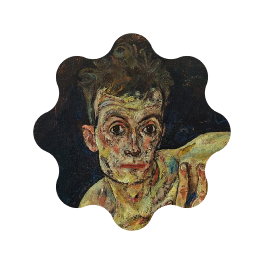
Self-Portrait with Physalis

Egon Schiele

Egon Schiele

1912

Scene

The painting shows the artist half-length against a stark background with his body tightly framed and slightly cropped at the edges. His head is turned sharply to the right, fixing the viewer with an intense gaze.

Figures

Egon Schiele depicts himself with an enlarged, penetrating eye that has a disturbingly bright red pupil. His posture, featuring a sharply angled shoulder and elongated neck, suggests both self-assertion and vulnerability.

Symbolism

The physalis, or Chinese lantern plant, appears behind the figure and is often interpreted as a symbol of the fragility and transience of life. The plant’s delicate, cage-like forms surround the artist, adding an ambiguous, almost threatening aura to the background.

Craft

Schiele uses sharp, defining contour lines to construct the figure and emphasize bony, angular forms. This technique contributes to a sense of tension and psychological intensity.

Impact

Widely regarded as one of Schiele’s most important self-portraits, the work is frequently reproduced in surveys of 20th-century painting. It remains a touchstone for discussions of Expressionist self-representation and modern subjectivity.

1 / 5

Tags

Self-portraitureTension

Craft

Movement

Expressionism

Expressionism

1905 - 1925

Distorted forms and intense color conveyed inner emotion over realism. Artists rejected naturalistic representation to express psychological tension and modern anxiety.