HomeDiscoverSaved

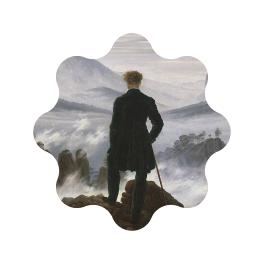
Wanderer above the Sea of Fog

Caspar David Friedrich

Caspar David Friedri...

1818

Scene

A single male figure stands on a rocky outcrop, looking out over a vast, mountainous landscape veiled in fog. Jagged peaks emerge from the fog like islands in a clouded sea, while the horizon remains indistinct, merging earth and sky.

Figures

The central figure is dressed in a dark green coat and holds a walking stick. He is seen from behind, a device known as the Rückenfigur, which invites the viewer to adopt his vantage point and share his solitary contemplation.

Symbolism

The fog is often interpreted as a metaphor for the unknown, uncertainty about the future, or the boundary between material and spiritual realms. The mountain peaks and rugged rocks symbolize the sublime power and permanence of nature, against which human life appears small and transient.

Craft

Friedrich uses atmospheric perspective, with sharp details in the foreground rocks and figure giving way to increasingly blurred forms in the distance to suggest depth and mystery.

Impact

The painting is considered one of the most important and representative works of German Romanticism and a quintessential image of the Romantic sublime. It is widely reproduced and referenced in popular culture as a symbol of introspection and existential searching.

1 / 5

Tags

FiguresIsolationLandscapeAwe

Craft

Movement

Romanticism

Romanticism

1780 - 1850

Emphasized intense emotion, drama, and the sublime power of nature, prioritizing individual experience and imagination over reason.