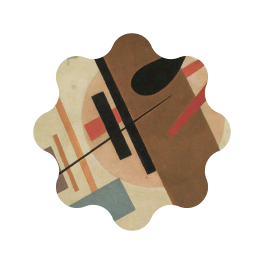
Suprematism
About
Beyond the Visible World
By the 1910s, avant-garde artists had shattered traditional representation, yet most abstract work still echoed recognizable forms or emotional turbulence. Suprematism promised something more radical: pure feeling through pure geometry, painting freed entirely from depicting objects, nature, or narrative.

Black Square

Kazimir Malevich
1915
Shape as Absolute
When you see flat geometric forms floating on white backgrounds, when color exists without shading or depth, when squares and circles feel weightless yet commanding, you're in Suprematism. Compositions reject perspective entirely. There is no up or down, no horizon, no gravity. Art becomes a spiritual exercise in non-objective sensation.

Artists
Artworks


